Definition
Die casting, a metal casting process, refers to injecting molten or semi-molten metal into metal dies with complex inner cavities under high pressure, with the metal solidifying and crystallizing inside the enclosed mold cavity.
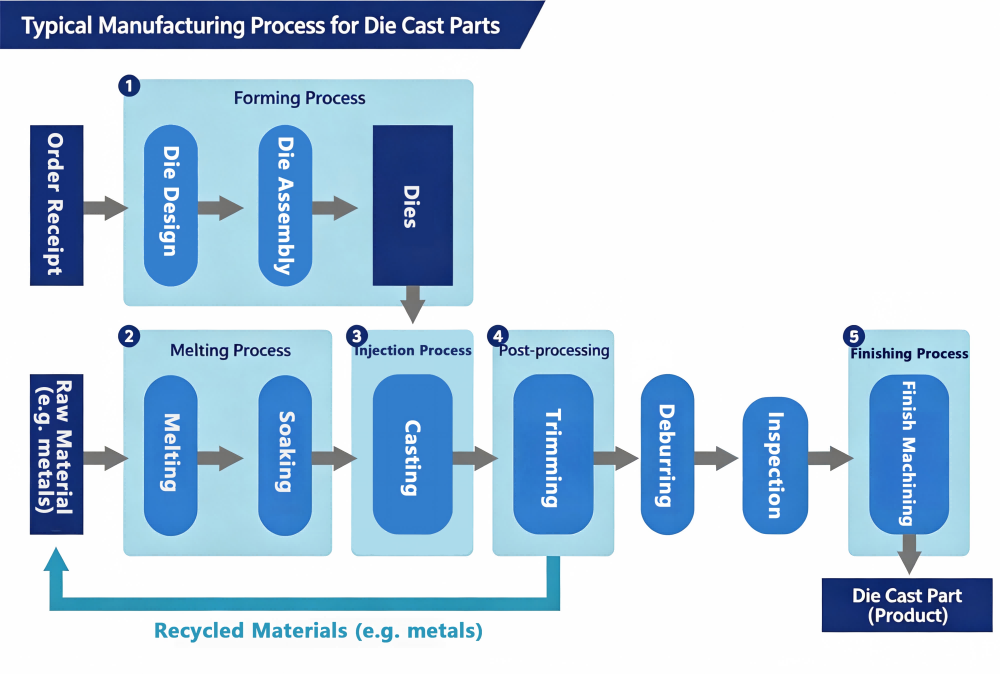
Process flow is listed below
Common Materials for Die Casting
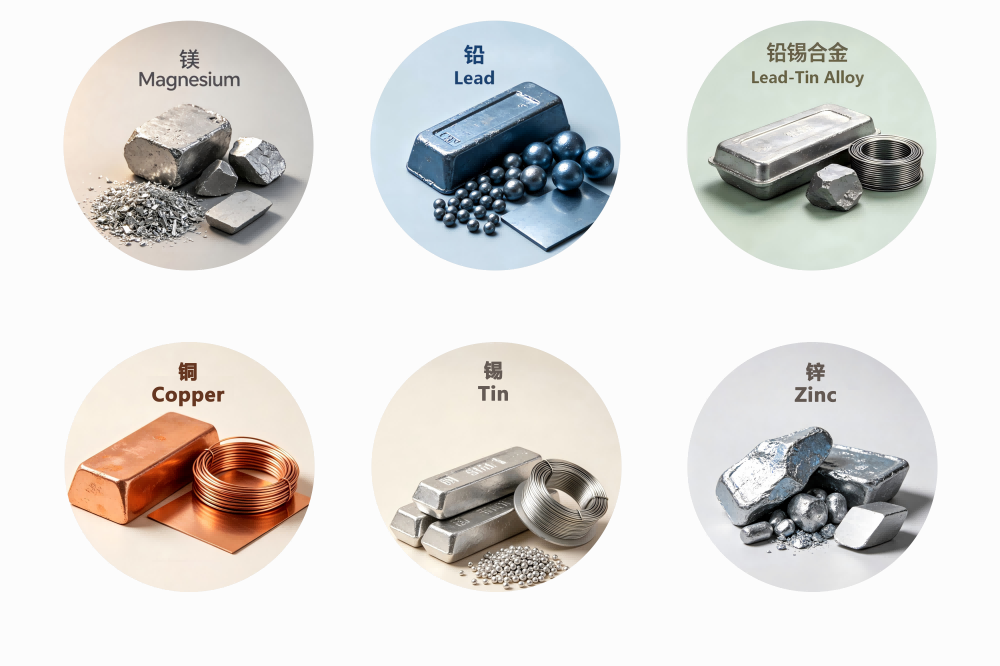
Die casting dies are generally fabricated from high-strength alloy steel. Most die-cast components are made of non-ferrous materials, including alloys of magnesium, lead, lead-tin alloys, copper, tin and zinc. The most common aluminum alloy grades are ADC10, ADC12, A380 and A356. We accept custom material grades specified by clients.
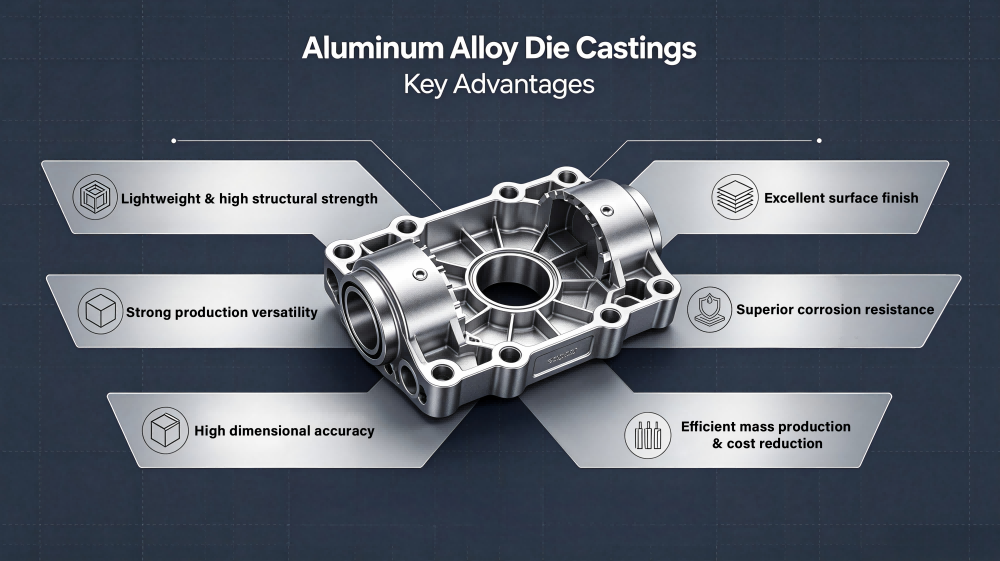
Aluminum alloy die castings account for the largest proportion of all die-cast products, with the following prominent advantages:
- As a lightweight alloy, aluminum can be made into lightweight components without compromising structural strength.
- It boasts strong versatility, supporting the fabrication of thin-walled parts in both simple and complex geometries with high dimensional accuracy.
- Aluminum castings deliver excellent surface finish and controllable surface roughness.
- Aluminum castings feature outstanding corrosion resistance, along with superior thermal and electrical conductivity.
- High-speed forming is available for mass production, saving production time and cutting overall costs.
Advantages of Die Casting
1. High dimensional accuracy
2. Superior surface finishes, with a typical roughness of Ra 1.6 ~ 6.3μm.
3. Wide material selection & high material utilization
4. Capable of producing complex parts with thin walls and deep cavities.
5. Uniform grain structure delivers high tensile strength and hardness.
6. Ultra-high production efficiency, ideal for mass production.
7. Insert casting is available
Application Fields
- Automobile & tractor manufacturing
- Instrument & electronic instrument industry
- Agricultural machinery, medical equipment and so on.
Typical Die-cast Parts
- Engine cylinder blocks, cylinder heads, transmission housings, engine hoods;
- casings & brackets for instruments and cameras, pipe joints, gears, etc.
Machines with different Tonnages suit castings with different weights
|
Die Casting Machine Tonnage (t) |
Allowable Net Weight of Aluminum Workpiece (kg) |
|
380 |
1.0-1.3 |
|
400 |
2.3 |
|
630 |
4.2 – 6.0 |
|
900 |
7.0 – 9.0 |
|
1288 |
10.0 – 14.0 |
|
1600 |
12.0 – 18.0 |
|
2000 |
18.0 – 25.0 |
|
2500 |
30.0 – 42.0 |
|
3000 |
35.0 – 48.0 |
|
3500 |
40.0 – 55.0 |
|
4000 |
52.0 – 65.0 |
Different Die Casting Processes for Diverse Customer Requirements
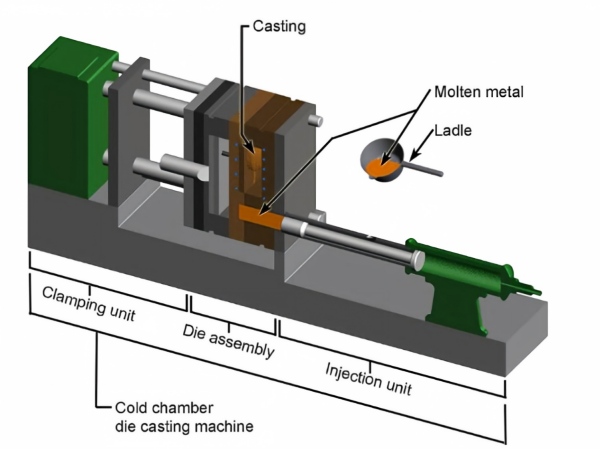
Classified by injection structure of die casting machines: Hot Chamber & Cold Chamber Die Casting. Specialized machines are required respectively.
Hot Chamber Die Casting: Suitable for low-melting-point alloys including zinc, tin and magnesium, mainly for mass production of medium & small parts such as valves and hardware fittings.
Cold Chamber Die Casting: Applicable to high-melting-point materials like aluminum and copper alloys, ideal for large & heavy components such as engine blocks and transmission housing.
We provide one-stop customized services covering product design, mold development, die casting and precision machining.
If you have product drawings but are unsure about the proper machine tonnage or material selection, feel free to send us your product information. Our professional team will tailor the optimal process solution for you.