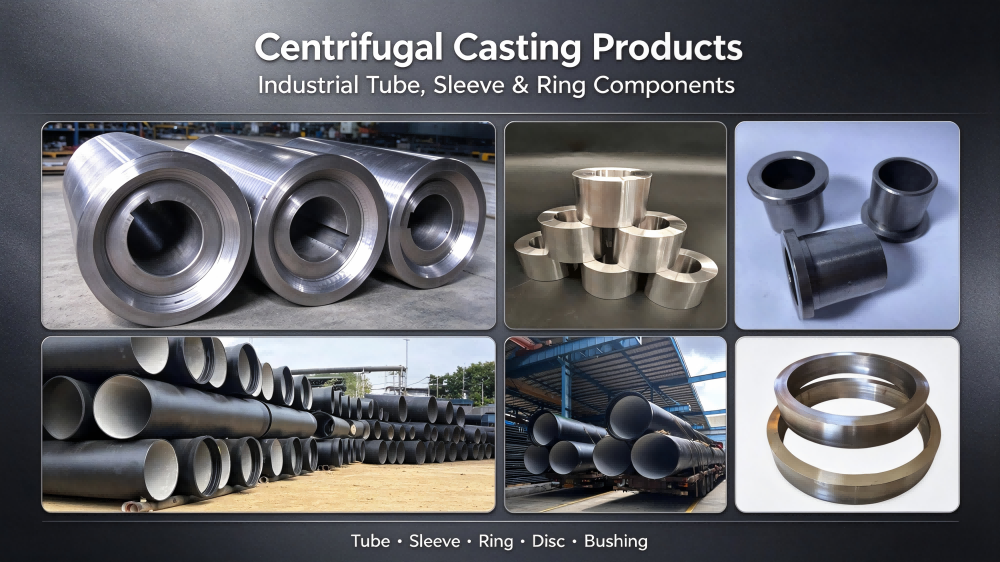
Definition
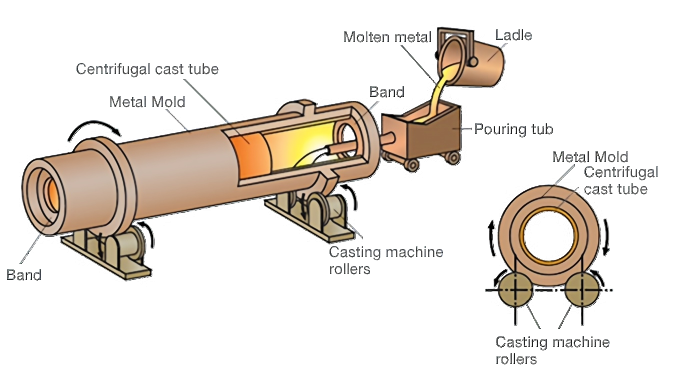
Centrifugal casting is a casting process in which molten metal is poured into a high-speed rotating mold (typically at 300–3000 rpm), and solidifies against the mold wall under centrifugal force, producing thin-walled cylindrical or hollow metal parts. It is widely used for industrial components such as pipes, shaft sleeves and bushings.
Advantages
- Castings feature high density, superior strength and fewer defects; density is improved by 5%–10% compared with sand casting.
- Suitable for cylindrical parts with thin and thick walls, no core required.
- High material utilization, no gating or riser system, metal loss less than 3%.
- Capable of multi-layer composite metal casting.
- High production efficiency, suitable for mass production of axisymmetric parts such as water pipes and bearing sleeves.
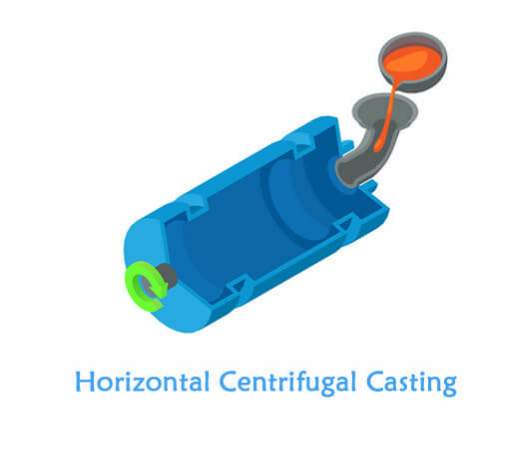
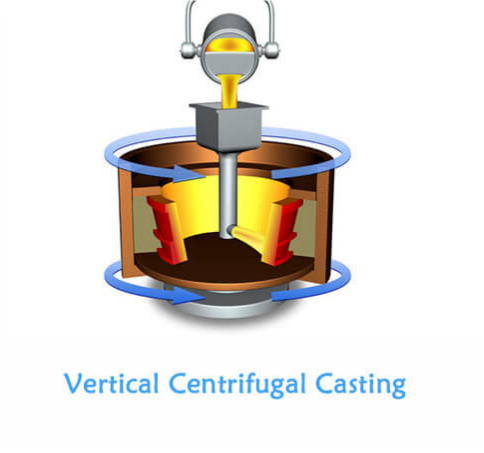
Horizontal Centrifugal Casting VS Vertical Centrifugal Casting
|
Horizontal Centrifugal Casting |
Vertical Centrifugal Casting |
|
|
|
|
|
| Rotation Axis |
Horizontal centerline, axis parallel to the ground |
Vertical centerline, axis perpendicular to the ground |
| Suitable Shape |
Long cylindrical & tubular parts (length over outer diameter) |
Annular, disc & sleeve parts (outer diameter over height) |
| Wall Thickness |
Uneven wall thickness at top and bottom if the diameter or height is relatively large |
Uniform centrifugal force around the circumference, good consistency of radial wall thickness |
| Inner Surface |
Well-formed, inner surface close to a perfect cylinder |
Liquid surface forms a paraboloid, inner surface is non-standard cylindrical |
| Advantages | Suitable for long workpieces; one-time forming, smooth molten metal filling; high density of tubes | Suitable for large-diameter rings; Stable forming; balanced circumferential force; uniform density |
Production Process
- Mold preparation: Clean, preheat and coat with refractory material.
- Metal melting: Melt the required metal material into liquid state and maintain it at proper temperature.
- Mold rotation: Set the rotational speed according to part dimensions (typically 300–3000 rpm).
- Pouring: Molten metal spreads rapidly over the mold wall during rotation.
- Directional solidification: Solidification proceeds from outside inward, with impurities driven toward the inner surface.
- Demolding & post-processing: Extract the casting, followed by machining, heat treatment and other operations
Application Field