|
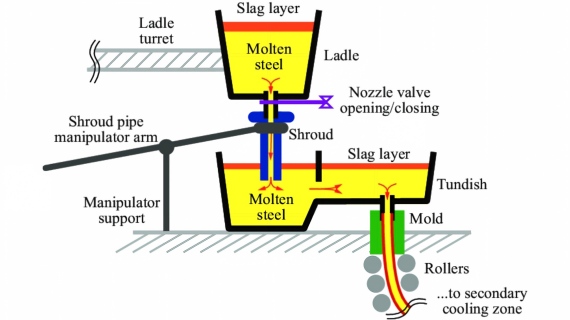
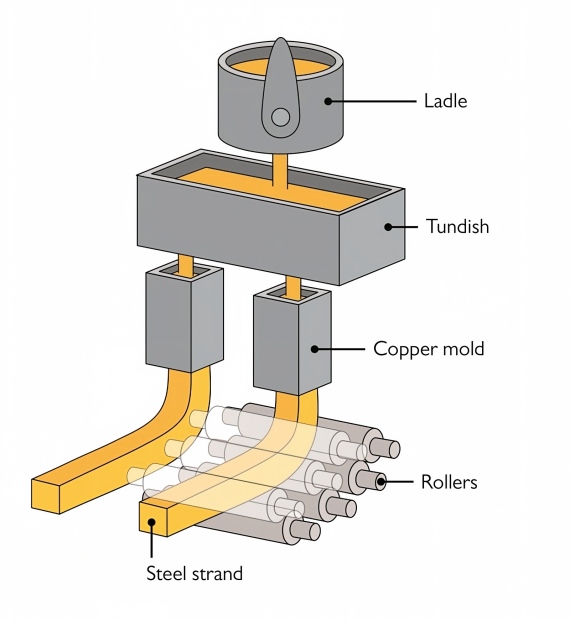
Process Introduction Continuous casting is an efficient metal forming technology. Simply put, molten metal is continuously fed into the mold, with its outer layer solidifying first. The semi-solid strand is continuously drawn out, cooled to full solidification and cut to specified lengths, realizing continuous production. |
|
|
|
Process Principle The core is balancing two key parameters:
The strand undergoes controlled cooling in the mold and secondary cooling zone, achieving progressive solidification from the surface inward. |
Applicable Materials
Ferrous metals: carbon steel, stainless steel, bearing steel, spring steel, tool steel, etc.
Non-ferrous metals: aluminum alloys, copper, brass, bronze, zinc, magnesium, lead and tin alloys.
*Note: The material needs good fluidity in liquid state. This process is unsuitable for brittle, crack-prone alloys.
Applicable Products
This process produces blanks, which require rolling or forging to become final parts:
- Slab: for automotive sheets and pressure vessel steel plates
- Billet: for round steel, rebars and bars
- Bloom: raw material for large forgings, rails and large-diameter round bars
- Hollow blank: raw material for copper and aluminum hollow profiles
- Special-shape blank: H-beam and other special cross-section profiles
Application Fields
The blanks are widely used in metallurgy, railway transit, construction machinery, mining equipment, wind power, automotive industry, electrical components and general machinery. Typical products include rail blanks, axle parts, forging stock, chassis parts, transmission shafts, gears and copper busbars.
Advantages
Compared with other casting processes, continuous casting delivers below advantages:
- Higher metal yield and less scrap.
- Uniform internal structure and stable quality.
- Lower energy consumption and operating costs.
- Easy to realize automatic production, with higher overall production efficiency.
Production Process
- Molten Metal Preparation
- Tundish for Stabilization & Inclusion Removal
- Initial Solidification in Copper Mold
- Secondary Cooling
- Withdrawal and Straightening