Definition
Principle: Low‑pressure die casting (LPDC) is a casting process where molten alloy is driven upward into the mold cavity by gas pressure and solidifies under pressure to form castings. LPDC is ideal for thick‑walled parts, but not suitable for thin‑walled components with wall thickness below 3 mm).
Key Features: Low‑pressure filling, low‑pressure solidification.
Common Materials for LPDC: Non‑ferrous metals such as aluminum and magnesium.
LPDC Process Steps
- Melt the metal alloy in the melting furnace.
- Transfer the molten metal into the holding furnace beneath the mold.
- Force the molten metal through the riser tube into the mold cavity.
- Solidify the metal under constant pressure.
- Release the applied pressure.
- Cool the mold and eject the finished part.
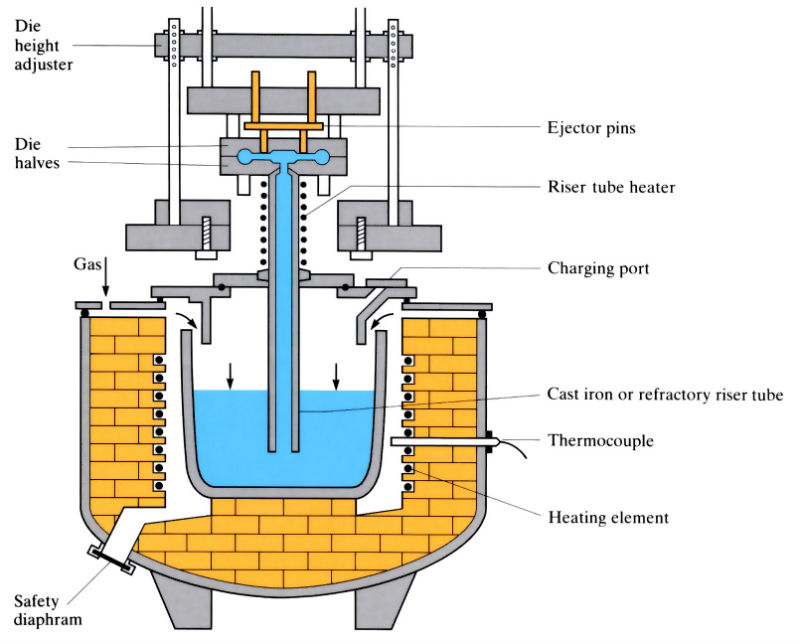
LPDC Advantages
Quality and Precision
- LPDC produces castings with high strength and excellent mechanical properties.
- Owing to smooth filling, the process generates fewer casting defects and less porosity than high‑pressure die casting.
- It delivers good surface finish, reducing post‑machining operations and cutting production costs.
- The process enables precise control over molten‑metal flow, ensuring consistent quality in mass production as well as higher dimensional accuracy and tighter tolerances.
- It supports sand cores for forming complex internal cavities, creating intricate structures that cannot be achieved via high‑pressure die casting.
Economic Efficiency
- LPDC generally requires lower equipment investment than high‑pressure die casting, making it suitable for startups and budget‑constrained capacity‑expansion projects.
- Molds experience lower wear and thermal stress, delivering longer service life and higher return on investment.
Application Fields
- Automotive industry: wheel hubs, cylinder heads, engine blocks, suspension components
- Aerospace: turbine blades, structural parts, lightweight alloy components
- Industrial machinery: pump housings, valve bodies, hydraulic components
- Electrical & electronics: heat sinks, motor housings, conductive parts
- Consumer goods: cookware, home appliance accessories, decorative components
- Transportation: rail transit components, marine engine parts
- New energy: wind power components, solar support structures
- Complex structural parts: thin‑wall, high‑strength components with tight dimensional tolerances
Differences Between LPDC and HPDC
* When to Choose Low Pressure Die Casting (LPDC)
- LPDC is ideal for parts requiring high dimensional accuracy and superior surface finish.
- It delivers castings with minimal internal porosity by suppressing gas‑related defects.
- It works well for components with complex geometries or intricate internal cavities; the process supports sand cores.
- It is suitable for large components that need excellent mechanical properties and structural integrity, such as automotive and aerospace parts.
- It fits small‑to‑medium production runs and delivers longer mould service life with reduced tool wear.
- It enables molten metal recycling to improve production sustainability.
* When to Choose High‑Pressure Die Casting (HPDC)
- HPDC is designed for high‑volume mass production with fast cycle times.
- It is best‑suited for relatively small parts featuring thin‑wall sections.